
Reference 02
Dave McKean's biography: from a Thames village to the drawing board
The biography runs quieter than the images suggest: one county childhood, one art school, one long marriage of scissors, paint and camera that never really relocated.
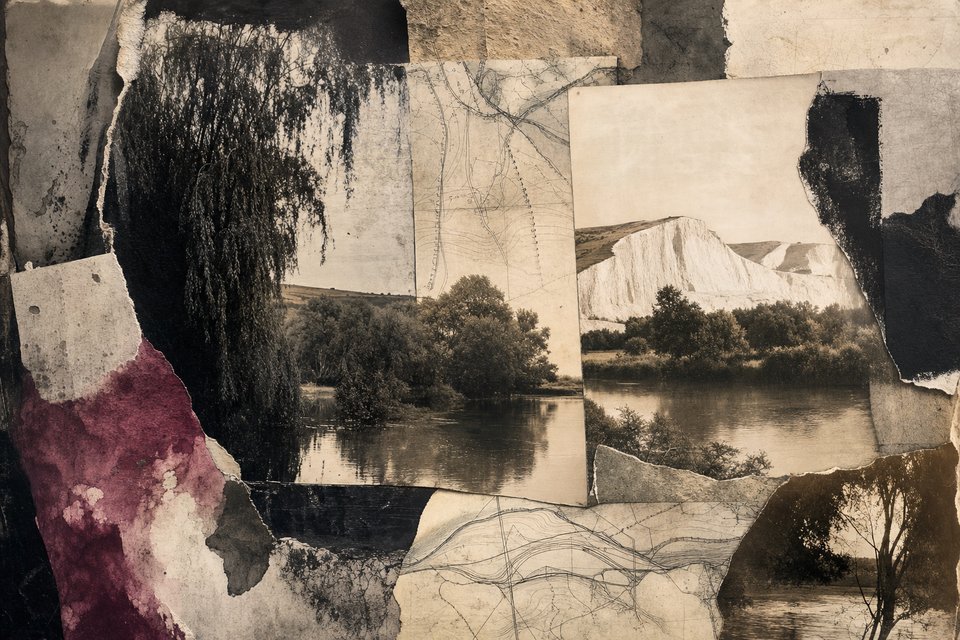
Taplow, 1963: Dave McKean's childhood inputs
Dave McKean was born in Taplow, Berkshire, in 1963, and the inputs of that childhood are unusually well documented because interviewers keep asking. Marvel comics first, then the American horror anthologies from Warren, then Heavy Metal magazine. Max Fleischer's Superman cartoons and Monty Python's cut-out animation arrived through the television, and surrealism arrived sideways, through paperback covers, record sleeves and posters rather than galleries.
He drew constantly. Nothing in the record suggests a dramatic conversion moment, only a boy by the Thames who never stopped.
Berkshire College of Art and Design, 1982–1986
The formal training came at Berkshire College of Art and Design, and McKean has been consistent about what mattered there: the rental shelf. The college's video library fed him Polanski, Besson, Bergman, Dreyer, Murnau and the rest of world cinema, and the framing habits of those directors settled into his pictures long before he made films himself. Expressionism and abstract art pulled the palette dark; Francis Bacon, Egon Schiele, Edgar Degas, Picasso and Russell Mills supplied the figure lessons; Winsor McCay, José Muñoz and Scott McCloud kept comics respectable.
He was selling illustration before graduation, which mattered practically: by the time he left in 1986 there was already a portfolio, and already a habit of treating no commission as beneath the full effort.
1986: the meeting that organised the career
The London small-press orbit around Escape Magazine introduced him to a young journalist named Neil Gaiman in 1986. Violent Cases followed in 1987, Black Orchid in 1988, the Sandman covers from 1989, and the shape of the next decade was set. The full account of that partnership fills its own section; the biographical point is simpler. McKean's career never had a slow apprenticeship, and he has said the abruptness suited him.
Dave McKean's working life since
The pattern that emerges from thirty-plus years of interviews is of an artist who organises life around uninterrupted studio time in the south of England, works alone unless a production genuinely requires a team, and hires through open calls when it does. He advises students to master fundamentals before style, to invite criticism and act on it, and to guard the work from outside interference once it is underway.
The jazz piano is not a footnote. Music structures several of the major books, Cages most of all, and he has performed live around exhibition openings. Asked what feeds the pictures, he has listed architecture, fashion and food alongside the expected painters, and the honest answer visible in the work itself is: everything, filed under dim light.
Frequently Asked Questions
Where was Dave McKean born?
In Taplow, Berkshire, in 1963, a semi-rural village on the Thames west of London. The river landscape resurfaces decades later in the personal books, most visibly in Black Dog and Raptor.
Where did Dave McKean study art?
At Berkshire College of Art and Design, from 1982 to 1986. By his own account the college's video library mattered as much as the studios: Bergman, Polanski, Dreyer, Murnau and Besson rentals shaped his framing for good.
Was Dave McKean already working as a student?
Yes. He took illustration commissions while still enrolled, and within a year of leaving had co-created Violent Cases. There was no wilderness period; the career started before the degree ended.
Does Dave McKean play music?
He is a serious jazz pianist, and it shows in the work: Cages centres on a musician, and he has performed and recorded around his exhibitions. Philip Glass sits high among his declared listening.
Where can I follow Dave McKean's new work?
His studio site, davemckean.com, carries news, commissions information and a shop run by the artist's own studio. For the published record, the works index and timeline on this site track the milestones as they are confirmed.
What is Dave McKean doing now?
Making books, pictures and exhibitions from his studio in the south of England, most recently the graphic novel Raptor and ongoing gallery projects. The timeline page here tracks the milestones as they are confirmed.