
Reference 09
Dave McKean's style and technique: collage, paint and pixels
Every McKean image answers the same question differently: how many kinds of making can one picture hold before it stops being one picture?
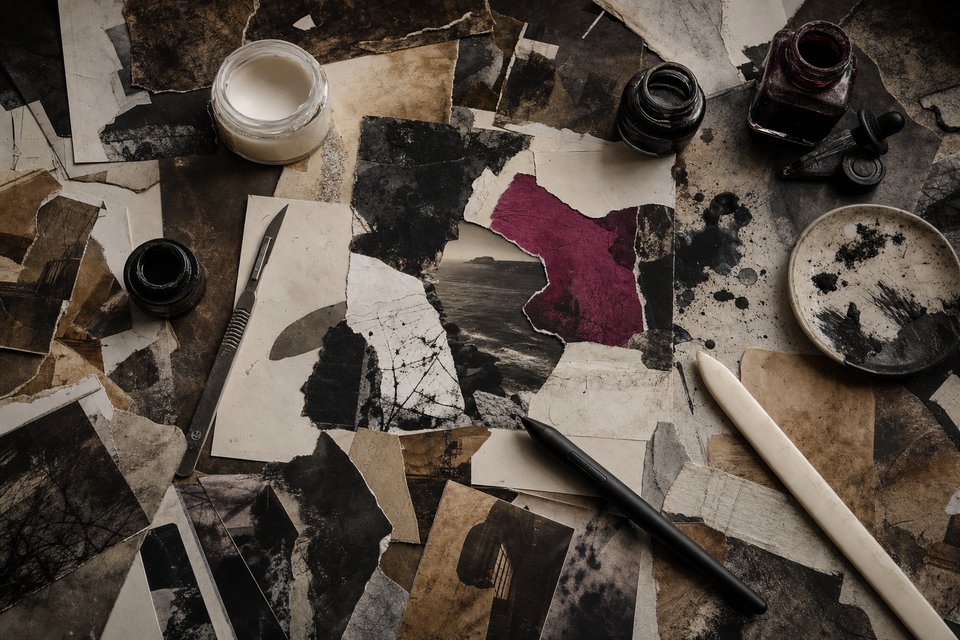
The Dave McKean worktable method
The process, reconstructed from decades of interviews and process features, starts physical: pen, brush-pen, ink or pencil on paper, photographs shot for the purpose, objects arranged and lit. Digital tools enter late, as the binding agent. Photoshop composites the layers, InDesign or Quark handles design work, and for moving images the chain extends through Final Cut, After Effects and Maya. The order matters to him: material first, computer second, so the pixels inherit real texture instead of simulating it.
He builds simple and layers upward, a habit he recommends to students more often than any other.
Dim lighting, dark hues, visible seams
Three signatures make the work identifiable at a glance. First, dim and sparing light: images lit like stage corners, with darkness doing compositional work. Second, the palette, layered greys, browns, maroons and deep blues that critics keep calling eerie and buyers keep framing anyway. Third, the seams: collage edges, torn paper and register marks left visible, so the viewer watches the image being assembled while reading it. Smoothness, in this studio, is a defect.
The figure: posture before face
His human figures get built from stance, muscle and tension rather than facial expression, the Schiele and Bacon inheritance put to narrative use. In the comics this does real storytelling work: a Cages page can carry a conversation on shoulder-angles alone. In the children's books the same skill softens into gesture, which is why the wolves feel dangerous and the children feel real.
Influences, absorbed rather than quoted
The influence list runs long, from Max Ernst's collage novels through Warren-era Berni Wrightson to the video-library directors, and the full roll-call sits in the biography. What separates McKean from most influence-lists is digestion; nothing in a finished image reads as quotation. The exception proves it: Black Dog deliberately lets Paul Nash's war paintings surface, and the effect is startling precisely because borrowed style is otherwise absent.
Asked where the work goes next, he tends to answer with materials rather than plans, lately clay, stage space and projection. The technique was never the collage. It was the appetite.
Frequently Asked Questions
What technique does Dave McKean use?
Mixed media, genuinely mixed: drawing, painting, photography, found objects and sculpture combined in one frame, with digital composition binding the layers since the mid-nineties. Most images begin as physical material and end in Photoshop.
What software does Dave McKean use?
Photoshop for composition, InDesign or Quark for layout and design, Final Cut for editing, After Effects for motion work and Maya for 3D, the toolchain he has described in interviews since MirrorMask made the question unavoidable.
Why is Dave McKean's work so dark?
Partly palette, partly philosophy. He favours dim, sparse lighting and layered greys, browns, maroons and deep blues because they carry emotion without illustration-brightness, and critics have connected that habit to the surrealists and expressionists he studied.
How does Dave McKean draw the human body?
From posture outward. Muscle, weight and stance carry the character; faces often blur, fragment or vanish entirely. The approach owes visible debts to Egon Schiele and Francis Bacon and gives even his gentlest books their undertow.
Who influenced Dave McKean?
By his own telling: Max Ernst, Berni Wrightson, Max Fleischer and Monty Python early; Francis Bacon, Degas, Picasso, Schiele and Russell Mills from painting; Winsor McCay, José Muñoz and Scott McCloud from comics; Bergman, Polanski, Dreyer, Murnau and Besson from the college video library.
What does Dave McKean think of CGI?
His long-stated position is that digital technology earns its place as one more material with its own grain, and fails when it merely copies reality. He builds simple, then layers, and warns against letting any tool set the ideas.
Does Dave McKean take students or assistants?
Not as standing practice. He works alone on personal projects and recruits through advertised positions when a production needs a team, so a portfolio submitted to an open call is the realistic route.
Which contemporary artists does Dave McKean admire?
Names he has offered in recent years include Michel Gondry, Walter Sickert, Werner Tübke, Paul Nash, John Bellany, Anselm Kiefer and Rachel Whiteread, with Philip Glass the constant on the studio stereo.